When we think about health in menopause, when the body no longer produces oestrogen, we think of symptoms like hot flushes, brain fog or poor sleep. Less visible is the protective role of oestrogen in your brain, your bones and your metabolism. Without oestrogen, you lose that protection.
Muscle is rarely mentioned when we talk about menopause, and when it is, it's about strength or how we look. Yet muscle is an organ, and an important one. Learning that about muscle changed how I see exercise. Every time you use your muscles, they release substances that benefit your brain and bones, support your metabolism and body composition, help control your blood sugar and calm inflammation. In this way muscle can help support these systems that lose oestrogen's protection. And as the loss of oestrogen speeds up muscle loss, your muscles need your attention more than ever.
Why call muscle an organ?
When you use your muscles, especially when you exercise, they produce highly beneficial substances called myokines and release them into the bloodstream. These myokines act as messengers: they travel through the body and send signals to the other organs.
This is why muscle is called an endocrine organ. Like your thyroid and ovaries, muscle releases substances into the blood that act elsewhere in the body. In menopause, your ovaries stop producing oestrogen and you can't change that. But your muscles are an endocrine organ you can keep working for you.
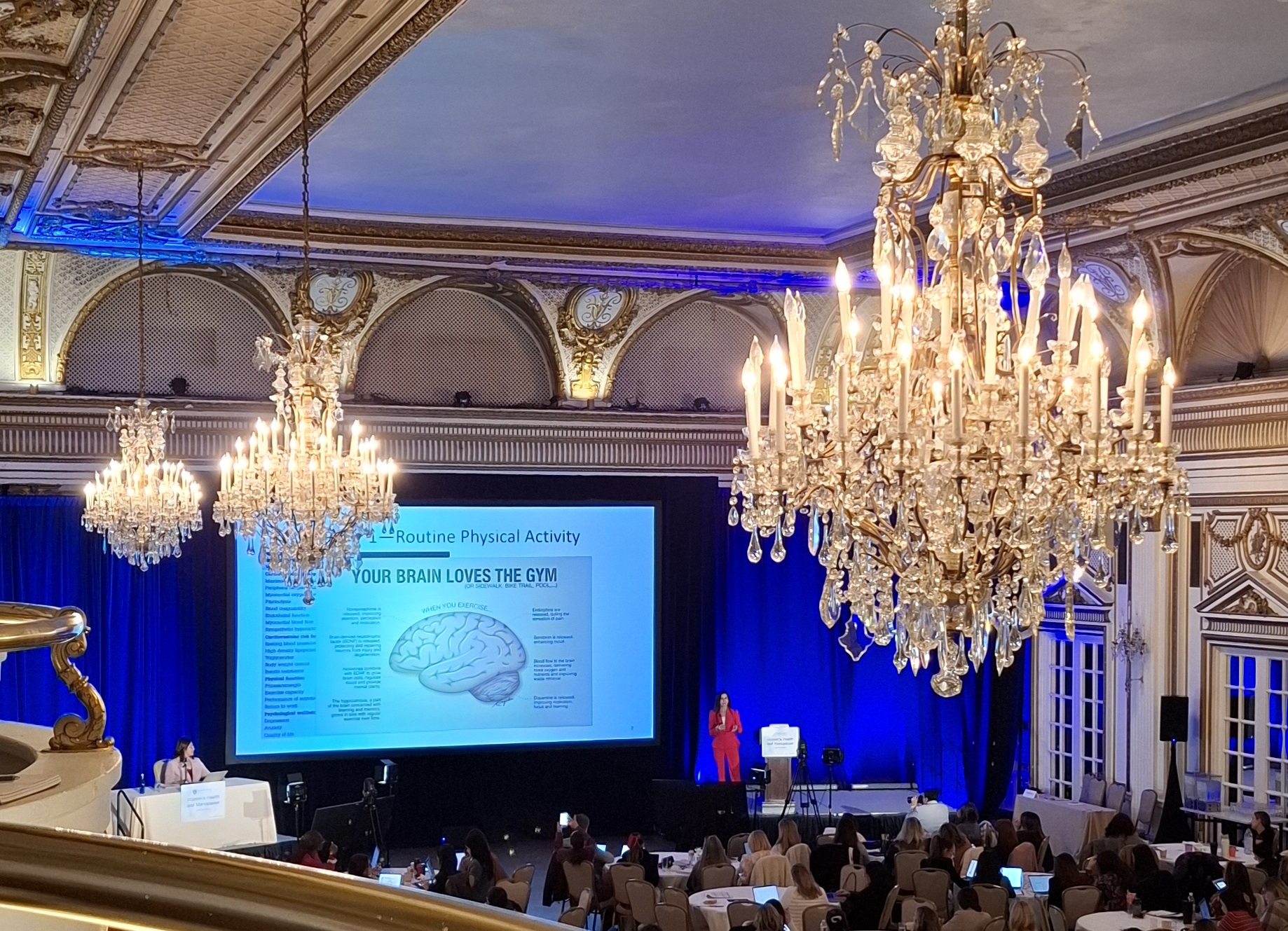
In the brain, research suggests myokines help raise levels of a protein called BDNF, which helps brain cells grow and build new connections, especially in the hippocampus, the part of your brain central to memory and learning. Research in postmenopausal women links regular exercise to a larger hippocampus. Strength training in particular is linked to sharper thinking and better memory. So your muscles don't just move you. Through the myokines that they produce, muscles support your health throughout your body, including your brain.
Muscle is also central to your metabolism. Think of muscle as the body's glucose sponge: after a meal, muscles soak up sugar from the bloodstream to use as fuel or store for later. In fact, muscle is the largest site in the body for taking up glucose. The more muscle you have, the bigger your sponge and the better your body can manage blood sugar. And as you will read below, a bigger glucose sponge also plays a part in counteracting the belly fat many women struggle with in menopause.
And of course, muscle is what keeps you strong and protects you against frailty. Strength is what allows you to keep living independently as you age. It's easy to take that strength for granted, but it doesn't stay on its own: without regular strength training, it slowly slips away.
What happens to muscle in menopause?
Muscles have receptors for oestrogen, and oestrogen plays an active role in building and keeping healthy muscle. It supports the repair and regeneration of muscle tissue and helps limit inflammatory damage.
Some muscle loss comes with age regardless. But the lack of oestrogen in menopause speeds up muscle loss. Loss of muscle mass and strength is called sarcopenia. Women in menopause often notice they feel weaker, or that their body looks different even though their weight might not have changed. This is a change in body composition: muscle being lost and replaced by fat.
How is muscle loss connected to weight gain?
Many women find their weight creeping up in menopause, even when they eat and exercise as they always have. And it increasingly settles around the waist as belly fat. This is not a matter of willpower. It is a matter of how your biology changes in menopause.
To understand this, it helps to know how insulin works. Insulin is the hormone that manages blood sugar. Think of it as a door opener: when sugar enters the blood after a meal, insulin signals the cells to open their doors and let the glucose in, so they can use it as fuel. A lack of oestrogen in menopause makes your cells respond less well to this signal. This is called insulin resistance: the cell doors open less easily, so the body produces more insulin to get the glucose out of the blood.
Losing muscle adds to this. Less muscle means a smaller glucose sponge, so more sugar stays in the blood after meals. The body then responds by releasing more insulin to bring the levels down. With less muscle to take it up, that sugar has to go somewhere. Part of it goes to your fat cells, which can turn it into fat and store it. Insulin is a storage hormone and drives this. It tells your body to store fat and holds back fat burning. So when insulin levels in your blood stay high, it becomes easier for your body to store fat and harder to burn it, and your weight can gradually go up.
At the same time, the lack of oestrogen changes where your body stores fat. Before menopause, oestrogen directs fat to your hips and thighs. Without it, fat is increasingly stored around your belly, the fat storage pattern typical for men. Unlike the fat just under your skin, the belly fat that increases in menopause is largely visceral fat: it is stored deep around your organs. Visceral fat is active tissue: it releases inflammatory substances and fatty acids that make your cells respond less well to insulin, and it raises your risk of heart disease and type 2 diabetes. Over time, this becomes a vicious cycle: more belly fat makes the body produce more insulin, and that leads to even more fat storage.
Muscle also uses more energy at rest than fat does, so as muscle declines, the body burns slightly less each day. On its own that difference is small, but over the years it adds up.
The good news is that this works in reverse too. Building muscle enlarges your glucose sponge, improves how your body handles blood sugar, as less insulin is needed, and supports a healthier body composition. Strength training can help reduce belly fat, and combining it with high-intensity interval training (HIIT), short, all-out bursts of effort followed by a few minutes of recovery, works best for losing fat in menopause.
How does muscle affect bone?
Muscle and bone are closely connected. Every time muscles contract, they pull on bones, and that pull signals bones to stay strong. The harder muscles work, as they do in strength training, the stronger that signal. Muscle loss and bone loss often go hand in hand, and bone loss speeds up alarmingly in menopause because of the loss of oestrogen: women can lose up to 20% of their bone density in the first five to seven years after menopause. In Ireland, one in two women over 50 will break a bone because of osteoporosis. Building muscle is one of the best things you can do for your bones.
What you can do
Strength training. The most effective way to build and keep muscle is resistance training: working your muscles against resistance. I studied with Dr Stacy Sims. She is an exercise physiologist who specialises in women's physiology and is famous for her message that women are not small men. By this she means that exercise advice has mostly been based on research in men, while women's hormones, and the loss of oestrogen and progesterone in menopause, make their bodies respond differently. Based on her research, she emphasises that heavy lifting is not something to avoid after menopause: it is exactly what your muscles need, as long as you allow more time to recover. Heavy is relative, though. If you are new to strength training, start light, learn good technique, ideally with guidance, and build up gradually.
Muscles need a challenge that keeps increasing as they get stronger: a progressive stimulus. Lifting heavier weights, often called progressive overload, is one way to do this, but not the only one. You can also do more repetitions, move more slowly, rest less between sets or choose a harder version of an exercise. What matters is that your muscles keep being challenged, so they keep getting stronger.
There is an extra benefit here: when muscles work, they can open their doors to glucose even without insulin. So every training session helps your body manage blood sugar, even if you have become somewhat insulin resistant.
Training at home. You don't need a gym to get started. Strength training at home, with your own body weight, resistance bands or a pair of dumbbells, is a very good way in, and there are plenty of follow-along videos on YouTube to guide you. Choose videos from qualified instructors, and look for programmes that get progressively harder over time.
Going to the gym. Many women feel a gym is not for them: too intimidating, too full of people who seem to know what they're doing. That feeling is common, and it is worth moving past. Most gyms offer an introduction session, and a few sessions with a trainer can teach you the basics and good technique. Beginner or small-group classes are a good way in too. You don't need to lift heavy weights on day one. You just need to start, and the confidence grows with your strength.
Consistency. Muscle responds to what you do regularly, over months and years. A routine you can sustain is worth more than an intense programme you abandon. You might feel tired at first while your body adapts, so make sure to rest and recover. But soon enough, strength training starts giving you more energy and power, not less. Find a way to make it part of your life, and it becomes something that lifts you up rather than wears you down.
Protein. Muscles need protein to repair and grow, and with a lack of oestrogen, your body becomes less efficient at using protein. Experts recommend that women after menopause eat 1.1 to 1.5 grams of protein per kilogram of body weight a day, more than the standard 0.8 grams, to support muscle and bone. Dr Sims recommends considerably more for active women: around 2.2 grams per kilogram. Don't let these numbers put you off. They are not meant to be counted gram by gram, but to show how much more protein your body requires in this phase of life. Many women eat less protein than their body needs. A simple way to start is a good portion of protein at every meal. Spreading it across the day also helps your body use it better.
Hormones. Hormone replacement therapy (HRT) replaces the oestrogen your body no longer makes in menopause. Because oestrogen plays such an active role in maintaining and building muscle, HRT supports your muscles. And HRT's benefits go well beyond muscle: the loss of oestrogen affects every cell, tissue and organ in your body, from your brain and bones to your heart. Whether HRT is right for you, and what type and dose, is a decision that deserves a proper, informed conversation. HRT does not replace strength training: your muscles still need the work.
It is never too late
Whatever your age and wherever you are starting from, your body will respond to training. And every time you use your muscles, you are doing far more than building strength: you are sending beneficial messengers to your brain and other organs, supporting a healthier metabolism and protecting your bones. Muscle truly is your longevity organ, your ticket to good health and an independent later life. Building and keeping muscle is an essential part of aging powerfully. It changes how you feel and look today and supports your future health.
Take control, build your muscles and build a stronger, healthier body!